BAFR-UK people and partners

Jump to:
Core academic team
Partner organisations
Advisory Board members
Core academic team

Prof Aled Jones - BAFR Project Lead

Prof Aled Jones is the inaugural Director of the Global Sustainability Institute (GSI) at ARU. Prof Jones’ work in climate finance has been recognised by the State of California and he has received a key to the city of North Little Rock, USA.
Prof Jones is the lead for a £2 million BBSRC research project exploring food resilience in the UK awarded in 2024, and in 2020 was Co-Investigator on a project led by the University of Exeter, that won £4 million from the UK Government to explore energy policy modelling. In 2016 he was Co-Investigator of an ESRC Centre of Excellence, led by the University of Surrey, a £6 million investment over five years.
Prof Jones’ research particularly focusses on the finance sector and government and how they will respond to the impacts of global resource trends and climate change as well as tail risk and how shocks cascade within society. He chairs the Institute and Faculty of Actuaries’ Biodiversity Working Party and sits on the Scientific Advisory Group for the Global Food Security initiative which feeds into the UK research councils and across government. He is an author on the 3rd Climate Change Risk Assessment for the UK Government. He was a member of the UK-US Taskforce on the Impact of Extreme Weather on US/UK Food Security and a President Bill Clinton Distinguished Lecturer.
Dr Davide Natalini - Senior Research Fellow

Dr Davide Natalini is an interdisciplinary environmental social scientist and is Course Director for the MSc Sustainability at ARU (run with the Eden Project). His work focuses on exploring complex social-ecological systems by applying systems-based methods, participatory approaches, and quantitative modelling.
Davide has led and contributed to major research projects on food security, environmental conflict, and nature-based integration, collaborating with international organisations and UK government departments.
Davide joined ARU’s GSI in 2013 as a PhD researcher on the Global Resource Observatory, developing an agent based model to explore how resource scarcity, price volatility and political fragility can contribute to food and fuel riots. This early work combined quantitative modelling with systems thinking and informed discussions with UK government partners and subsequent major projects such as the Global Chaos Map project, which he co-led.
Since then, Davide has established a distinctive interdisciplinary profile at the nexus of environmental security, complex social ecological systems, community resilience, and policy engagement, leading and contributing to a number of externally-funded research projects. His research has been cited in reports by the IMF, UN, World Bank, ILO, IPCC and EU Joint Research Centre, and has informed UK Ministry of Defence strategic publications.
Davide has extensive experience in participatory and community engaged research, leading knowledge exchange work packages in projects funded by the Nuffield Foundation and British Academy. His work regularly brings together policymakers, local authorities, community organisations and vulnerable groups through workshops, arts based methods, and serious games.
Dr Elena Cini - Research Fellow
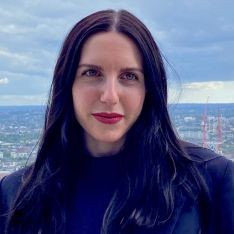
Dr Elena Cini is a Postdoctoral Research Fellow at ARU's GSI in Cambridge, where she is involved in the BBSRC-funded BAFR project aiming to strengthen the resilience of the UK’s food system. She is an interdisciplinary scientist with experience in ecology, agri-environmental research, and conservation social science.
Previously, she worked as Postdoctoral Research Officer at Bangor University on the NERC-funded iDeer project. Her research focussed on investigating attitudes toward the management of wild deer to anticipate future land management scenarios amid UK’s net-zero targets. She earned her doctorate at the University of Reading as part of the Horizon EU PoshBee project, where she explored factors driving bee declines and how to support sustainable beekeeping in Europe.
Dr Elta Smith - Visiting Fellow

Dr Elta Smith is an interdisciplinary social scientist and Visiting Fellow at ARU, where she is a core team member of the BAFR-UK project. Her research focuses on food systems, health and environmental policy, with particular expertise in policy evaluation, impact assessment and foresight methods, including horizon scanning, scenario analysis and serious gaming.
Over more than two decades, Elta has directed research and evaluation studies for UK, EU and international organisations, including Defra, the Food Standards Agency, the European Commission and the European Parliament. She was formerly Director of the Innovation, Health and Science group at RAND Europe, led the food chain policy team at ICF, and supported Defra's delivery team in preparing the National Food Strategy in 2021.
She was Policy Impact and Synthesis Champion for the UKRI Agri-Food for Net Zero Network+ in 2025, where she led the Roadmap for Resilience: A UK Food Plan for 2050. She also leads the impact evaluation of the UKRI Transforming UK Food Systems programme.
Elta is Co-founder and Director of Root and Reason, a community interest company working on food system resilience, and Chair and Trustee of the Food Ethics Council. She holds a PhD in Public Policy from the Harvard Kennedy School and a BA in Environmental Science and Policy from Barnard College, Columbia University, and was S.V. Ciriacy-Wantrup Postdoctoral Fellow at the University of California, Berkeley.
Maryla Hart MSc - Project Manager

Maryla Hart manages the BBSRC-funded BAFR-UK project, which involves working with multiple stakeholders from across and beyond the food system. Maryla brings seven years’ experience in NHS corporate governance, projects and admin (2014-2021), during which time she took on additional roles as Sustainability Manager and Health and Wellbeing Rep.
More recently, Maryla was employed in consultancy, fundraising and knowledge exchange placements. Maryla has a long-standing active interest in environmental and social justice, including food systems, and completed her Sustainability Masters at ARU.
Qualifications
MSc Sustainability, ARU
BA (Hons) Sociology with Social Policy, University of Warwick
Prof Sarah Bridle - BAFR Project Co-Lead and Chair in Food, Climate and Society

Prof Sarah Bridle is a transdisciplinary researcher driven by the need to tackle climate change, focusing on a quantitative approach to helping transform food systems to steward change to new kinds of futures.
Sarah's current research focuses on synthesising, exploring and effectively communicating environmental and nutrition impacts of different dietary options, with the aim of driving changes in food production methods and portfolios to be healthy for people and planet. Sarah founded the Take a Bite out of Climate Change project, including leading a stand at the Royal Society Summer Science Exhibition 2019.
Sarah has a unique combination of expertise including interpreting large data sets using statistical methods, with a degree in Natural Sciences and a PhD in Astrophysics from the University of Cambridge (2000), and statistical cosmology research in France (2000-2001), Cambridge (2001-2004), UCL London (2004-2012), Manchester (2013-2021) and York (2021-present).
Author of >100 refereed publications with >10,000 citations (h>50), Sarah has won prestigious awards including a Royal Society University Research Fellowship, the Royal Astronomical Society's Fowler Award and ERC Starting and Consolidator Grants.
Sarah's book, Food and Climate Change – Without the Hot Air was published in September 2020 by UIT Cambridge.
Dr Christopher Lyon - Fellow

Dr Christopher Lyon is an interdisciplinary environmental social scientist passionate about integrating natural and social science, and the humanities in ways that help society to understand and navigate Anthropocene challenges, especially in the long-term. He has previously worked on the social dimensions of climate, food security, natural resource, disaster, and ecosystem challenges.
Christopher has held postdoctoral positions at McGill University and the University of Leeds, with a PhD in Geography from the University of Dundee. His current research at the Leverhulme Centre for Anthropocene Biodiversity (LCAB) explores multi-century human-environmental futures on Earth and ways to plan for those futures now.
This work builds on the outputs of a White Rose University Consortium funded project he led at Leeds called Refugia of Futures Past, which involved modelling different climate change scenarios to the year 2500, together with vegetation, heat stress, and crop changes to begin to broadly picture the kinds of futures we might have to adapt to. Its aim was to provide some initial and indicative research to understand the kinds of climate futures our grandchildren may face, with outputs published in Global Change Biology and The Conversation, receiving international news and science media interest.
Dr Juan Pablo Cordero - Research Fellow

Juan Pablo is based in the Department of Environment and Geography at the University of York, and is interested in the development of scientific software, big data research, visual representation of data, predictive numerical models and the effect of measurement uncertainty on model parameter estimation.
On the BAFR project, and previously in his role in FixOurFood, Juan Pablo has developed food system models which can help predict the effect of systemic transformations of food production, storage, processing and consumption on measurable indicators with an emphasis on the effects on business models, dietary choices and environmental impact. He has also worked on identifying how environmental and resilience goals can be achieved when systems are faced with shocks and crises.
Juan Pablo is a data scientist with a PhD in Astrophysics from the University of Manchester, and has previously worked in large international scientific collaborations such as the Dark Energy Survey and the SkyPy collaboration.
Email: [email protected]
Prof Angelina Sanderson Bellamy - BAFR Project Co-Lead

Prof Angelina Sanderson Bellamy Professor of Food Systems at UWE Bristol and Director of Root and Reason CIC. Angelina is passionate about researching ways to transform our food systems to be sustainable, healthy and accessible for all.
She has been awarded over £25 million in funding and has extensive experience in leading challenge-led interdisciplinary sustainability research on food systems, ecological resilience, ecosystem services and social justice. Angelina uses a systems approach and place-based methods for understanding society’s grand challenges, especially as they relate to the food system.
Before working at UWE, Angelina was Senior Research Fellow and Associate Dean for Environmental Sustainability at Cardiff University. She also worked as a Research Fellow at the Stockholm Resilience Centre and Stanford University’s Wood’s Institute for the Environment. Her research career has been based at interdisciplinary research institutes, where she enjoys collaborating with colleagues across social, natural and physical sciences.
Angelina’s undergraduate degree is in Human Biology from Stanford and her PhD is in Ecology from Stockholm University. Angelina's experience draws from working across Latin American and UK food landscapes and she is passionate about making our food systems environmentally sustainable, healthy and accessible for all.
Holly Chalmers - Research Associate

Holly Chalmers is a researcher at UWE Bristol whose work examines the social dimensions of sustainable agriculture and food system transformation. Her research explores how farmers, communities, policymakers, and other stakeholders can work together to build resilient food systems capable of responding to climate, environmental, and societal change. Holly works on the LUNZ Hub Land data and digital tools for Net Zero, Nature and Society and BAFR-UK projects.
In 2022, Holly completed her MSc in Food Policy at City, University of London. The course introduced systems thinking to her research approach and continues to influence her work now. Since graduating she has gained extensive experience working with government and regulatory bodies, including, Defra, Welsh Government, Food Standards Agency, Natural England and WRAP. Her work spans multiple facets and influences of food availability, affordability and acceptability.
Holly continues to seek new opportunities for food systems transformation that is fair and equitable. Recently acquired funding explores work patterns as a lever for food system transformation.
Qualifications
MSc Food Policy, City, University of London
Tom Youngman

Tom Youngman does policy-engaged research at the intersection of food system science, economics and complexity science. In addition to BAFR (scenario modelling and policy engagement) he is currently working on Defining high-carbon advertising: options appraisal, funded by Ad-Free Cities.
Tom spends most of his time as a doctoral researcher at the Institute for New Economic Thinking at the University of Oxford. He researches how agent-based macroeconomic models can be used to assess the distributional impact of climate mitigation policies.
He came to his current roles from the UK government's Department for Environment, Food and Rural Affairs (Defra). He worked in a range of policy and economics roles, most recently leading Defra's Net Zero Economics team. He regularly briefed Ministers and senior officials and has represented the UK on working groups at the OECD, EU and WTO. Prior to working at Defra, he worked at Prudential, Ecooo and Triodos Bank. When he's not thinking about the economy, you can find him at a gig, riding his bike, kitesurfing, or holding a placard at a picket line.
Prof Rosie Green - BAFR Project Co-Lead

Prof Rosie Green's research focuses on the links between climate change and human health with a special focus on food systems.
She is currently co-leading the Pathfinder Initiative project exploring health impacts of global actions to mitigate climate change, which reported its initial results in a Lancet Commission. She is a co-investigator on the ClimateFlation and BAFR-UK projects exploring food system resilience to climate change in the UK, the PAICE project exploring carbon mitigation in G7 countries, and the Visibilize4ClimateAction project researching health impacts of climate change in Kenya.
Rosie joined LSHTM in 2011 following her PhD in Epidemiology, and was promoted to Professor in 2022. She was Co-Director of the LSHTM Centre on Climate Change and Planetary Health from 2023-26, and is Head of the Planetary Health research group at LSHTM with ~25 researchers. Her work has also fed into the UK’s Food Strategy and the Seventh Carbon Budget. She sits on the WHO guideline development group for sustainable dietary change.
Dr Anouk Reuzé - Research Fellow

Dr Anouk Reuzé is Research Fellow specialising in Nutritional Epidemiology and Planetary Health at LSHTM. Her research explores how dietary changes can contribute to healthier and more sustainable food systems.
She primarily contributes to two research projects: ABC-SHEADE, where she evaluates pathways towards sustainable food consumption in Europe, and SHEFS-SA, where she investigates the nutritional and health impacts of dietary transitions in Southern Africa.
With a background in food science engineering, Anouk completed a PhD in Public Health at Université Sorbonne Paris Nord. Her doctoral research examined the factors influencing the shift from animal-based to plant-based dietary patterns among non-vegetarian French adults, using behaviour change theory.
Dr Karen Rial-Lovera - BAFR Project Co-Lead

Dr Karen Rial-Lovera is Co-Dean for Agricultural Science & Practice (ASP), Associate Professor in Agriculture, and Head of International Partnerships at the RAU.
She holds a degree in Agricultural Engineering, an MSc in Agriculture and Forestry Research from the University of Santiago de Compostela (Spain), and a PhD in Crop Systems completed in collaboration with the RAU and Coventry University.
Her research focuses on agroecological and regenerative practices and agricultural systems, with projects in the UK, Europe and Sub-Saharan Africa. She currently leads interdisciplinary research on resilient agrifood systems and sustainable nutrient management.
Karen has held academic roles at RAU, including the Douglas Bomford Trust Agricultural Engineering Chair (2017-2019), and at Nottingham Trent University, where she led the BSc (Hons) Agriculture course (2019-2023).
In her leadership roles at the RAU, she oversees ASP academic programmes and research while championing equity, inclusion, and student voice. She also oversees the RAU’s international partnerships across the Middle East, India, and Europe.


